Instant Download
Your unique download link appears right after you complete your purchase, and is also sent instantly to the email address you provided.
Couldn't load pickup availability

Your unique download link appears right after you complete your purchase, and is also sent instantly to the email address you provided.
Yes
Internal-Medicine-Primary-Care
physiatrists, neurologists, geriatricians, internists, family practitioners
Mixed (Video + PDF)
Mixed (Video + PDF)
Other
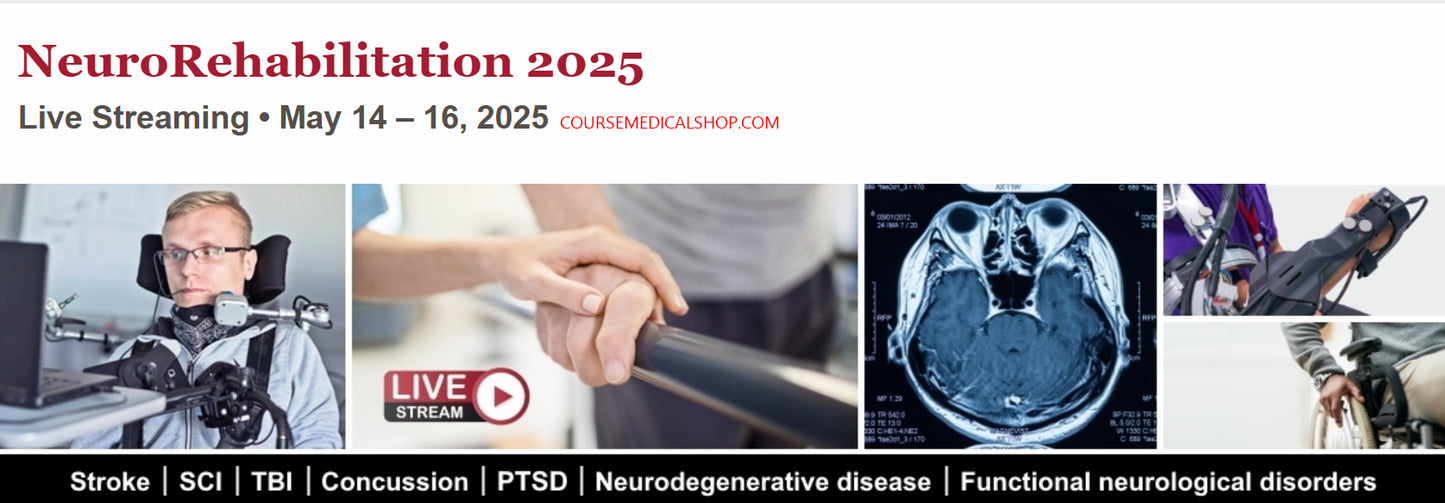
Comprehensive Neurorehabilitation Update Cutting-edge strategies, updates, and best practices for state-of-the-art rehabilitation
NeuroRehabilitation 2025 will be held online this year, using live streaming, electronic Q&A, and other remote learning technologies.
Overview
Patients with stroke, SCI, TBI, and functional and degenerative neurological diseases face significant disruption to so many facets of their lives, and clinicians are left with so many treatment dimensions to consider, that rehabilitation is never simple. These challenges are compounded by the fact that rehabilitation approaches are now in a period of rapid expansion. It’s difficult to stay current with, choose, and use the best options for neurorehabilitation—yet this is key to optimizing patient outcomes.
Comprehensive updates
Education to further your expertise in guiding patients to their maximum level of function
Evidence-based approaches to challenging and complex cases
Case studies
Take-home tools
A learning experience to heighten your success in effectively and efficiently helping your patients gain the skills that will improve their health, function, and quality of life
Enhanced and Accelerated Recovery
Rehabilitation of memory and executive skills after stroke and TBI
Spasticity management
Pharmacologic options for aggressive behavior after TBI
Treatment of pressure ulcers
Functional neuroimaging in disorders of consciousness
Early mobilization in the ICU
Life Participation Approach to Aphasia
Music therapy
The shoulder post-stroke
Lower extremity orthotics after stroke
Musculoskeletal overuse after SCI
Pediatric TBI
Improved Quality of Life
Wellness groups for stroke survivors
The SCI consumer perspective
Vision rehabilitation after stroke
Women’s health in SCI
Resilience and adjustment after SCI
Pharmacologic treatment of dementia
Approaches to obesity in neurorehabilitation
Evolving Treatment Options
Artificial intelligence in neurorehabilitation
Gamified neurorehabilitation treatments
Forced exercise in Parkinson’s disease
Cryoneurolysis for spasticity
Psycho-pharmacogenomics
Brain-computer and brain-spinal interfaces
Expanded Understanding of a Wide Range of Neurological Conditions
Stroke recovery
Functional neurologic disorders
Mild TBI and PTSD in the military
Chronic traumatic encephalopathy
Severe TBI and disorders of consciousness
Chronic TBI
Emotional dysregulation and affective processing after TBI
Domestic violence and TBI
Amyotrophic lateral sclerosis
Autonomic dysfunction after SCI
Visual dysfunction after stroke
Who Should Attend
Physicians
– Physiatrists
– Neurologists
– Geriatricians
– Internists
– Family Practitioners
Physical Therapists
Occupational Therapists
Speech-Language Pathologists
Nurse Practitioners
Physician Assistants
Nurses
Psychologists
…and other health professionals interested in neurological rehabilitation
CEU Sign in and out links.pdf
May 14 Artificial Intelligence and Machine Learning in Neurorehabilitation – Paolo Bonato, PhD.pdf
May 14 Interactive Breakout Sessions 1A- Common Causes of Diagnostic Error in Patients with Severe Brain Injury (and Strategies to Avoid Them) – Joseph Giacino, PhD.pdf
May 14 Interactive Breakout Sessions 1B- Lower Extremity Orthotics After Stroke – Dawn Lucier, PT.pdf
May 14 Interactive Breakout Sessions 1C- The Perspective of People Living with SCI – Kimberly Anderson, PhD.pdf
May 14 Interactive Breakout Sessions 2A- Pediatric TBI – Brian Wishart, DO.pdf
May 14 Interactive Breakout Sessions 2B- Vision Rehabilitation After Stroke – Samira Mortazavi, OD.pdf
May 14 Interactive Breakout Sessions 2C- Sports and Exercise for People with SCI Kathleen Salas, PT, MHA.pdf
May 14 Interactive Breakout Sessions 3A- New Diagnostic Criteria for Mild TBI – Grant Iverson, PhD.pdf
May 14 Interactive Breakout Sessions 3B- Forced Exercise for Parkinson’s Disease – Jay Alberts, PhD.pdf
May 14 Interactive Breakout Sessions 3C- Brain-Computer and Brain-Spinal Cord Interfaces – Leigh Hochberg, MD, PhD.pdf
May 14 Interactive Breakout Sessions 4A-B- Rehabilitation of Memory Disorders After TBI and Stroke – Therese O’Neil-Pirozzi, ScD, CCC-SLP.pdf
May 14 Interactive Breakout Sessions 4C- Update on ASIA Classification – Marika Hess, MD.pdf
May 14 KEYNOTE- Early Mobilization of Patients in the ICU – Nicole Mazwi, MD.pdf
May 14 KEYNOTE- The Management of Spasticity – Monica Verduzco-Gutierrez, MD.pdf
May 15 Gamified Neurorehabilitation Strategies – Jenna Tosto-Mancuso, PT, DPT.pdf
May 15 Interactive Breakout Sessions 10A – Covert Consciousness in Severe TBI – Brian Edlow, MD.pdf
May 15 Interactive Breakout Sessions 10B – Music Therapy in Stroke and Parkinson’s Disease – Brian Harris, MA, MT-BC, NMT-F.pdf
May 15 Interactive Breakout Sessions 10C – Women’s Health After SCI – Chloe Slocum, MD, MPH.pdf
May 15 Interactive Breakout Sessions 5A – Recovery and Outcome After Severe TBI and Disorders of Consciousness – Yelena Bodien, PhD.pdf
May 15 Interactive Breakout Sessions 5B – Pharmacologic Treatment of Dementia – Scott McGinnis, MD.pdf
May 15 Interactive Breakout Sessions 5C – Resilience and Adjustment During Rehabilitation After SCI – Ann Marie Warren, PhD.pdf
May 15 Interactive Breakout Sessions 6A – Chronic TBI – Mel Glenn, MD.pdf
May 15 Interactive Breakout Sessions 6B – Models of Stroke Neurorecovery- The Cutting Edge – David Lin, MD.pdf
May 15 Interactive Breakout Sessions 6C – Aging with SCI – Sunil Sabharwal, MD.pdf
May 15 Interactive Breakout Sessions 7A-B – Rehabilitation of Executive Dysfunction After TBI and Stroke – Olivia Gampel, SLP and Emmaleigh Loyer, SLP.pdf
May 15 Interactive Breakout Sessions 7C – Update on Amyotrophic Lateral Sclerosis – Sabrina Paganoni, MD, PhD.pdf
May 15 Interactive Breakout Sessions 8A – Domestic Violence and TBI – Eve Valera, PhD.pdf
May 15 Interactive Breakout Sessions 8B – Life Participation Approach to Aphasia – Esther Herring, MS, CCC-SLP.pdf
May 15 Interactive Breakout Sessions 8C – Endocrine Issues After SCI – Shalender Bhasin, MD.pdf
May 15 Interactive Breakout Sessions 9A – Mild TBI and Post-Traumatic Stress Disorder in the Military – Lauren Brenner, PhD and Johnny Jarnagin, MD.pdf
May 15 Interactive Breakout Sessions 9B-C- Cryoneurolysis for Spasticity – Paul Winston, MD.pdf
May 16 Interactive Breakout Sessions 11A- Improving Psychological Health After Mild Traumatic Brain Injury with Building Emotional Self-Awareness Teletherapy (BEST).pdf
May 16 Interactive Breakout Sessions 11B- Wellness Groups for Stroke Survivors – Elizabeth Frates, MD.pdf
May 16 Interactive Breakout Sessions 11C- Assessment and Treatment of Pressure Ulcers After SCI – Jennifer Godfrey, RN, CWCN.pdf
May 16 Interactive Breakout Sessions 12A- Pharmacologic Approaches to Emotional and Behavioral Dyscontrol After TBI – Hannah Steere, MD.pdf
May 16 Interactive Breakout Sessions 12B- Neglect-Inattention After Stroke – Priyanca Shah, DO, MBA.pdf
May 16 Interactive Breakout Sessions 12C- Musculoskeletal Overuse in People with SCI – Dana Kotler, MD.pdf
May 16 Interactive Breakout Sessions 13A- Risk Factors and Clinical Manifestation of Chronic Traumatic Encephalopathy – Daniel Daneshvar, MD, PhD.pdf
May 16 Interactive Breakout Sessions 13B- The Shoulder After Stroke – Craig Rovito, MD.pdf
May 16 Interactive Breakout Sessions 13C- Autonomic Dysfunction After SCI – James Doan, MD.pdf
May 16 KEYNOTE Obesity and Cardiometabolic Disease in TBI, Stroke, and SCI Simon Driver, PhD.mp4
May 16 KEYNOTE Obesity and Cardiometabolic Disease in TBI, Stroke, and SCI Simon Driver, PhD.pdf
May 16 Psycho-Pharmacogenomics in Neurorehabilitation Alyson Wolz, DNP.pdf
May 16 Rehabilitation of Functional Neurologic Disorders Ginger Polich, MD.mp4
May 16 Rehabilitation of Functional Neurologic Disorders Ginger Polich, MD.pdf
May 16.mp4
Neuro Rehab Scheudle.pdf
NeuroRehab 2025 Completion Requirements OT-PT-SLP.pdf
NeuroRehabilitation 2025 Faculty Bios and Photos.pdf