Instant Download
Your unique download link appears right after you complete your purchase, and is also sent instantly to the email address you provided.
Couldn't load pickup availability

Your unique download link appears right after you complete your purchase, and is also sent instantly to the email address you provided.
Yes
Internal-Medicine-Primary-Care
rheumatologists, pain management physicians, primary care physicians
Mixed (Video + PDF)
Mixed (Video + PDF)
Other
Rheumatology and Pain Management for Primary Care
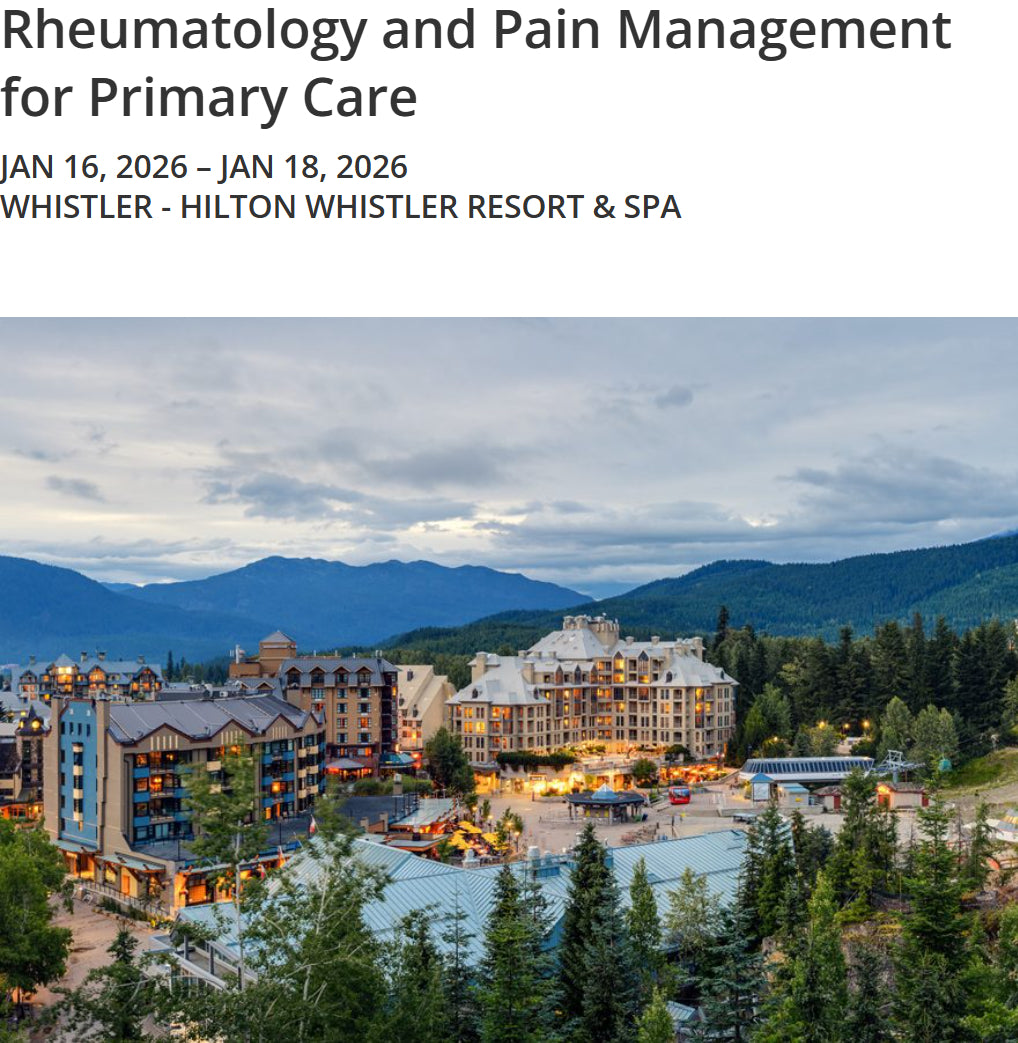
Whistler – Hilton Whistler Resort & Spa
This conference is designed to provide primary care practitioners with up-to-date, evidence-based information on commonly encountered issues in Rheumatology and Pain Management while suggesting pragmatic approaches to clinical management. The discussion-based format of the conference will encourage audience participation through dynamic lectures, case-based studies, and hands-on workshops. Keynote speakers will present and critically assess recent advancements and industry updates in Rheumatology and Pain Management to enhance the knowledge base and core competence of attendees. The successful completion of this interactive program diagnosing, treating, and prescribing the most effective courses of treatment, with the ultimate goal of improving patient outcomes.
Target Audience
All Physicians and other Healthcare Professionals seeking clinical information about various issues in Rheumatology and Pain Management.
*Note: these are continuous video recordings during the conference, they include individual lectures mentioned in the Detail section below
Friday, January 16th
Objectives: 1) Become familiar with recent pathophysiology related to mechanisms of fibromyalgia 2) Discuss recent clinical criteria for diagnosing fibromyalgia in a primary care setting 3) Identify a multidisciplinary approach that can be applied to patients with chronic widespread pain
Saturday, January 17th
Objectives: 1) Apply new pathophysiologic understanding to treating pain 2) Determine mechanisms of action for the various muscle relaxers and anticonvulsants commonly used to treat various chronic pain states 3) Use case examples to better understand titration and adjustment of adjuvant analgesics
Sunday, January 18th
Objectives: 1) Determine best practices for tapering and weaning patients off opioids safely 2) Formulate an approach for converting patients between adjunctive analgesics 3) Discuss updates in non-opioid pain pharmacology, including advanced combination therapies
Objectives: 1) Discuss the best approach in addressing the patient who is resistant to change 2) Describe a strategy for treating patients with anxiety around pain therapy 3) Characterize patients with clear addiction 4) Manage patients who are angry or upset in the office 5) Discuss the approach to patients who have lost self-control
Objectives: 1) Identify the features that are typical for primary osteoarthritis and those that may be a consequence of a different disease 2) Properly order imaging studies to aid in diagnosis and management 3) Manage treatment by using nonpharmacologic measures, such as weight reduction and exercise, supplements, cannabis for pain control, as well as medications for relieving joint symptoms 4) Discuss when to refer to surgery