Instant Download
Your unique download link appears right after you complete your purchase, and is also sent instantly to the email address you provided.
Couldn't load pickup availability

Your unique download link appears right after you complete your purchase, and is also sent instantly to the email address you provided.
Yes
Internal-Medicine-Primary-Care
internists, primary care physicians, cardiologists, endocrinologists, rheumatologists, infectious disease physicians
Video Only
Video Only
Other
1. Overview
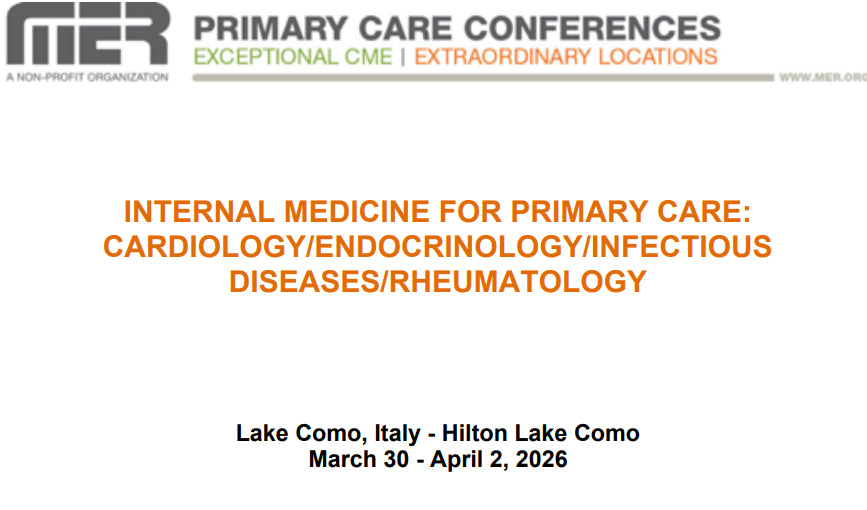
The “Internal Medicine for Primary Care: Cardiology/Endocrinology/Infectious Diseases/Rheumatology” is a conference organized by Medical Education Resources (MER), a non-profit organization.
The event is scheduled to take place from March 30 to April 2, 2026, at the Hilton Lake Como in Lake Como, Italy.
2. Learning Objectives
Develop patient-specific treatment plans for the management of type 2 diabetes.
Interpret the diagnostic criteria for dyslipidemia and design individualized treatment.
Identify the risks and benefits of utilizing bisphosphonates in the treatment of osteoporosis.
Identify the risks of abnormal thyroid function.
Describe the differential diagnoses of inflammatory arthritis based on clinical presentation and laboratory workup.
Utilize current evidence to design treatment strategies for osteoarthritis.
Diagnose and treat gout and pseudogout.
Compare the benefits and side effect profiles of pharmacologic treatment options for fibromyalgia.
List common causative pathogens for various respiratory tract infections.
Evaluate the severity of diarrhea and evaluate the need for treatment.
Discuss emerging infectious diseases including resurgence of vaccine-preventable diseases, zoonoses, and diseases related to animal exposures.
Describe the work-up, risk assessment and test selection of patients with suspected CAD.
Explain current concepts in the diagnosis and treatment of hypertension.
Implement treatment strategies reflective of recent guidelines and current evidence based medicine for heart failure.
Describe current diagnostic and treatment approaches to arrhythmias and atrial fibrilation.
3. Target Audience
This program is targeted to office-based primary care providers and other health professionals with updates in primary care medicine.
4. Topics
Endocrinology
Type 2 Diabetes Mellitus: Diagnosis and treatment; lessons from the DCCT; managing diabetic emergencies; screening; pre-diabetes.
Disorders of Thyroid Function: Prevalence, diagnosis and treatment options of hypothyroidism and hyperthyroidism.
Rheumatology
Differential Diagnosis of Inflammatory Arthritis: Clinical presentation and laboratory work-up and treatment for rheumatoid arthritis, systemic lupus erythematosus, spondyloarthropathies (SPA), infectious arthritis and systemic sclerosis; Treatment of RA with DMARDs; Treatment principles of SLE, Sjogren’s, SPA and PMR.
Osteoarthritis: Pathogenesis, diagnosis and treatment.
Crystal Disease: Gout & Pseudogout: Properly diagnosing and treating crystal diseases such as gout and pseudogout.
Fibromyalgia: Differential diagnosis and treatment of this difficult-to-manage pain syndrome; Treatment options of anti-epileptics and SNRI’s.
Infectious Diseases
Skin & Soft Tissue Infections: Presentation on important skin and soft-tissue infections and their prompt recognition, emphasizing evaluation and management strategies.
Respiratory Tract Infections: Discussion highlighting critical points regarding the diagnosis and management of pneumonia and bronchitis – with a focus on the impact of multidrug resistant pathogens.
Gastrointestinal Infections & Clostridiodes Difficile: Presentation on important enteric pathogens and their recognition, diagnosis and management; special emphasis on clostridiodes difficile colitis and related updates from the ID and infection control literature.
Emerging Infectious Diseases: Novel influenza viruses, resurgence of vaccine-preventable diseases, zoonoses and disease related to animal exposures (including vectors such as mosquitoes that bear west Nile virus and dengue), bioterrorism and food/waterborne illness.
Cardiology
Work-up of Patients with Suspected CAD: Risk factor evaluation and risk assessment models; Test selection including ECG, echo, nuclear and newer imaging modalities (including discussion of appropriate use criteria–AUC); The usefulness of CT scanning; The role of bio markers and EBCT; Suspected CAD in special populations (women, diabetics, the elderly).
Hypertension: The 2017 AHA/ACC Hypertension Guidelines; The 2024 ESC Guidelines for hypertension; Approaches to treatment thresholds and goals; Choices for initial and combination therapy; Resistant hypertension; Treating special populations: diabetics, the elderly, patients with renal failure.
Heart Failure: Etiologies and stages of heart failure; ACC/AHA Heart Failure Guidelines; Heart failure with reduced EF (HFrEF) and heart failure with preserved EF (HFpEF); Determining patients for referral using biomarkers, eg NT Pro BNP; Treatment options: ACE inhibitors, ARBs, ARNI, beta blockers, mineralocorticoid receptor antagonists, SGLT2i; The role of devices in treatment and antiplatelet drugs; Issues related to the hospitalized patient with acute decompensated heart failure and readmissions.
Arrhythmias: Types and symptoms of arrhythmias; Approach to the patient: when to treat, when to refer, when to admit; Evaluation of the patient with palpitations; Atrial fibrilation: the use of anticoagulants indications, CVA risk scores, warfarin vs newer oral anticoagulants, controlling heart rate vs rhythm; Ventricular and other arrhythmias: when are they serious.