Instant Download
Your unique download link appears right after you complete your purchase, and is also sent instantly to the email address you provided.
Couldn't load pickup availability

Your unique download link appears right after you complete your purchase, and is also sent instantly to the email address you provided.
Yes
Internal-Medicine-Primary-Care
internists, primary care physicians, gastroenterologists, neurologists, and psychiatrists
Video Only
Video Only
Other
1. Overview
2. Learning Objectives
Utilize history and physical examination to distinguish weakness from non-specific symptoms.
Utilize prevention and treatment strategies for cerebrovascular disorders.
Discuss the spectrum of sleep disorders and current management strategies.
Describe the differential diagnosis of headaches and migraines.
List current treatment recommendations for the management of lower GI bleeding.
Discuss the guidelines for colonoscopic colorectal cancer screening and surveillance.
Discuss options to prevent recurring pancreatitis.
Identify patients most at risk for pancreas cancer.
Compare the benefits and side effect profiles of pharmacologic treatment options for ADHD.
Describe strategies for identifying and treating substance use disorders.
Describe symptoms that move depression to plans for suicide.
Recommend appropriate pharmacologic and non-pharmacologic treatment for depression.
3. Target Audience
This program is targeted to office-based primary care providers and other health professionals with updates in primary care medicine.
Best for internists, primary care physicians, gastroenterologists, neurologists, and psychiatrists.
4. Topics
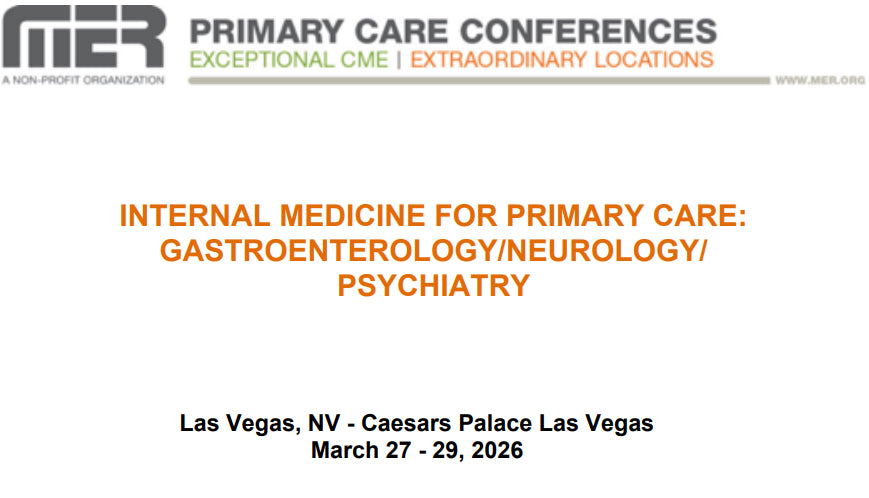
Friday, March 27, 2026
Neurology – Evaluating Weakness: Using the history and physical examination to distinguish weakness from non-specific symptoms; characteristics of neurological diseases that produce weakness; presentations of representative diseases of the nervous system.
Neurology – Cerebrovascular Disorders: Epidemiology; identifying the high-risk patient; treatment effects; transient neurological deficit: carotid, vertebrobasilar; non-specific cerebral symptoms; migraines vs. TIA; treatment options.
Neurology – Sleep Disorders: Epidemiology; assessing sleep patterns; causes and treatment of insomnia; causes, evaluation and treatment of sleep apnea; symptoms and treatment of narcolepsy.
Gastroenterology – Management of Lower GI Bleeding- From Occult to Massive: The correct use and interpretation of tests for occult blood in the stool will be discussed in relation to lower GI bleeding; focus on the utility of different diagnostic and management approached to the spectrum of patients presenting with hematochezia.
Saturday, March 28, 2026
Gastroenterology – Acute Pancreatitis: Etiology and Management: Recognition of acute and chronic pancreatitis; The etiology of pancreatitis and determination of next steps in management; Discussion of complications of pancreatitis and how to counsel patients on how to prevent recurrence of pancreatitis.
Gastroenterology – Pancreas Cancer Screening: Determination of who qualifies for pancreas cancer screening and how to refer for pancreas cancer screening; Discussion of the importance of the family history and genetic counseling; Discussion of how pancreas screening is accomplished.
Neurology – Headaches & Migraines: Basic headache mechanisms; headache history: characteristics, precipitating factors, medical conditions; migraine: common tension, classic, treatment, complicated, cluster, sinus; trigeminal neuralgia; Giant Cell Arteritis; brain tumor; subarachnoid hemorrhage; emergency room treatment.
Psychiatry – The Complexity of Adult ADHD: ADHD in adults with an emphasis on symptom identification; Co-occurring conditions; Psychiatric and medical differential diagnosis; evidence-based and FDA approved pharmacological treatments.
Psychiatry – Substance Use Disorders: Substance abuse history-taking to encourage patient honesty; Accurate diagnosis; Use of screening tools; Brief intervention; Recovery and treatment options; Motivational interviewing; Family symptoms and codependency.
Sunday, March 29, 2026
Psychiatry – Depression and Suicide: Assessment of depressive symptoms in adults; Assessment and mitigation of suicide risk; Treatment of depression.
Psychiatry – Psychopharmacology for Major Depression: History taking, diagnosis and treatment of depression across the lifespan; pharmacologic and non-pharmacologic treatment options; rational polypharmacy.