Instant Download
Your unique download link appears right after you complete your purchase, and is also sent instantly to the email address you provided.
Couldn't load pickup availability

Your unique download link appears right after you complete your purchase, and is also sent instantly to the email address you provided.
Yes
Diagnostic-Imaging
radiologists
Mixed (Video + PDF)
Mixed (Video + PDF)
Other
1. Overview
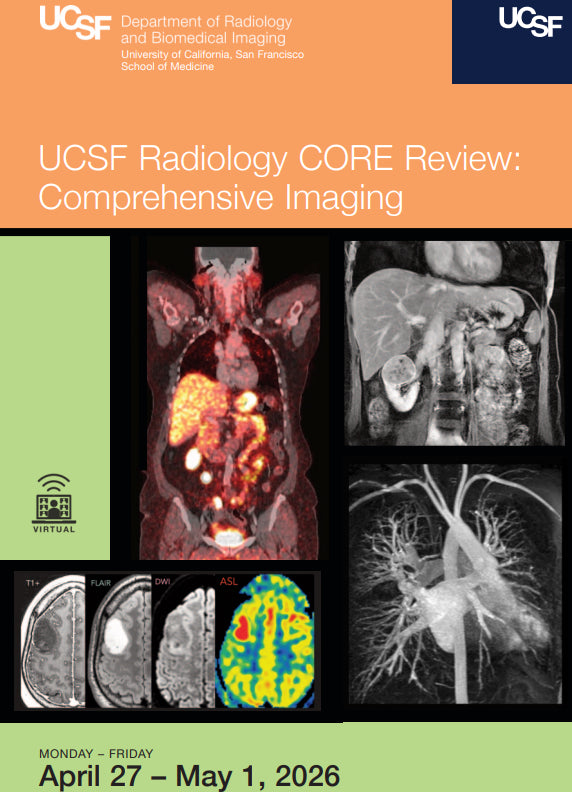
The course will consist of case-based, in-depth sessions on diseases of the major organ systems; as well as shorter focused lectures on physics, rad safety, cardiac, nuclear medicine and interventional procedures that are relevant to the general radiologist and radiologist-in-training.
The course will include a 90-minute session with multiple-choice questions on Non-Interpretive Skills relevant to radiology trainees.
To facilitate learning, all lectures will include rapid-fire cases and/or multiple-choice questions (MCQ), as well as “MCQ Galore” sessions that emphasize basic radiology principles in a fast-paced, question format that will be of clinical value to the radiologist on-call and in-training.
Course Format
Five full-day sessions Monday thru Friday, from 8:00 am to 5:00 pm Pacific Time (mid-day break).
Major subspecialties/organ systems will be covered in ten half-day sessions (GI, GU, Chest, Breast, Peds, Neuro, US ObGyn, Nuc Med, IR, MSK).
Sessions will include didactic lectures, rapid-fire cases and multiple-choice questions.
Modalities will include CT, MR, US, Breast and NucMed; as well as essentials for Rad Safety and IR.
50+ UCSF faculty speakers from all radiology subspecialties.
2. Learning Objectives
Identify imaging fundamentals of each of the radiology sub-specialties (organ systems);
Prescribe the appropriate utilization of imaging modalities (CT, MR, US, PET, Mammography) for different medical conditions;
Implement the appropriate imaging protocols for routine clinical presentations;
Recognize indications and markers for interventional procedures, as well as assessment of outcomes;
Apply classifications of pathophysiological mechanisms underlying human disease to facilitate differential diagnosis;
Refine imaging criteria to optimize image quality/findings and improve diagnostic interpretation.
3. Target Audience
4. Topics
01 Monday AM GI
02 Monday PM – GU
03 Tuesday – AM – THORACIC
04 Tuesday – PM – BREAST
05 Wednesday AM PEDS – NEUROVASC
06 Wednesday PM – NEURO
07 Thursday AM US OBGYN
08 Thursday PM CORE QS NUCS
09 Friday AM IR-NUC MED
10 Friday PM MSK